
There are moments when we can no longer think our way through what we're experiencing. Stress accumulates. The nervous system tightens. Old patterns repeat. We lose connection with ourselves, our bodies, and what matters.
And something in us keeps reaching for steadiness and well being anyway.
What a session is actually like
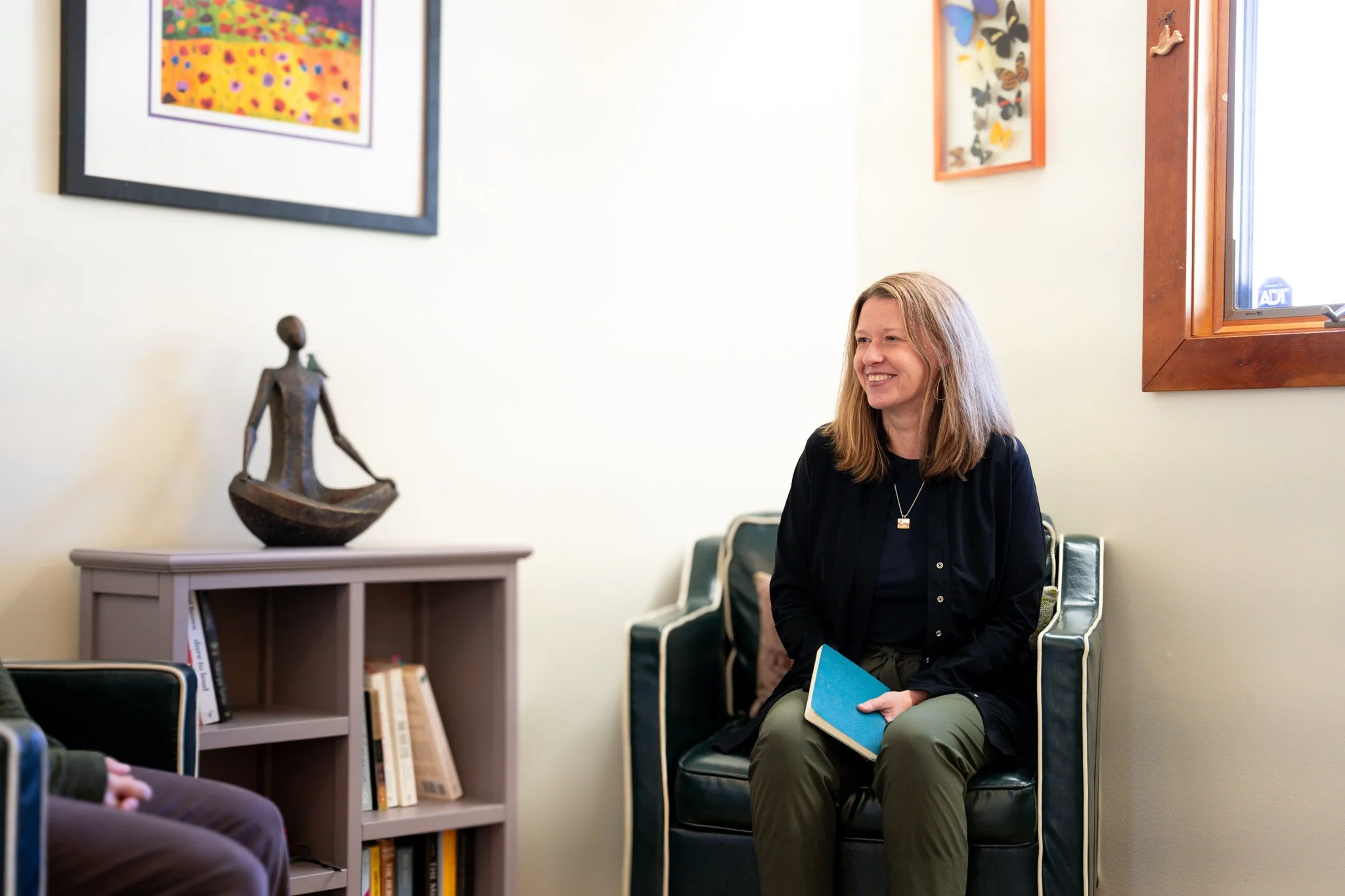
Closer to meditation than to talking about your week.
We slow down — actually slow down — until it becomes possible to see what's happening while it's happening. That's most of the work. Not fixing. Not analyzing. Seeing clearly, in real time, with someone sitting there with you.
The company matters more than people expect. Nervous systems settle in the presence of a settled nervous system. That's co-regulation, and it isn't a metaphor — it's how humans have always calmed down. A good deal of what shifts in these sessions shifts because you're practicing steadiness next to someone who has been practicing it for over 25 years.
We work with the foundations of mindfulness: the body, the feeling tone of experience, the mind itself, and the patterns running underneath all of it. Over a few months, steadiness stops being somewhere you visit and becomes something you have.

I may support you if you are….
overwhelmed, anxious, or emotionally exhausted
moving through grief, transition, uncertainty, or burnout
highly sensitive, and wanting to understand your own boundaries
disconnected from yourself, your body, or your sense of purpose
spiritually searching and wanting grounded, real-life support
in the middle of something that opened and won't close
This isn't about becoming a better version of yourself. It's about being able to meet your life more fully — with more presence, more honesty, and a good deal more kindness toward the person living it.
What this isn't
I'm not a therapist, and this isn't therapy or psychiatric care. If you're in acute crisis, what you need is clinical support, and I'll tell you so rather than take you on.
It's also not one conversation that sorts everything out. Seeing clearly is a skill, and skills take repetition. That's why we start with four sessions rather than one.
Where this comes from
In my early thirties I completed the four-year retreat teacher training at Spirit Rock and the Insight Meditation Society, studying with Jack Kornfield, Joseph Goldstein, Sharon Salzberg, Trudy Goodman, Guy Armstrong, and Phillip Moffitt — the generation that carried this practice west. I also studied at Naropa University, and spent years in the early 2000s with Ken Wilber's Integral Spiritual Center in Boulder and Denver, where the working question was how contemplative practice and Western psychology actually fit together.
What the tradition points at is unremarkable, in the best way. Underneath the noise, the reactivity, and the story you've been telling about yourself, there is something already awake and already kind. Not a state you achieve. Something you stop overlooking.
Buddhism has names for it. You don't need them. If you want to go into the dharma, we can go a long way in. If you'd rather never hear a Pali word, that costs you nothing here.
Deeper water
Some people come because something has opened and won't close. A practice went further than expected. For example, a psychedelic experience that left territory they can't find their way back through. A loss cracked something wide.
These states are real. They're far easier to move through alongside someone who knows the terrain than someone who's alarmed by it. I've spent over 25 years navigating consciousness, including its further reaches, and I'm available for those in a “spiritual emergency”.
It isn't the only thing I do. Most of this work is much more ordinary than that.
Kind Words from Past Mentors & Students:
“Emily Horn has served as a mentor and teacher for over eight years in our meditation teacher training program, and consistently offered our students skilled guidance, deep wisdom and her naturally compassionate support. In this and in her retreat teaching, Emily embodies the best qualities of a mature and dedicated meditation teacher.” —Tara Brach, P.h.D and Author of Radical Acceptance
“Emily is a wonderful teacher of mindfulness, beloved by her students, one of the best I have trained.”—Jack Kornfield, P.h.D, Founder and Buddhist Teacher at Spirit Rock Meditation Center
"Emily is one of the best next-generation mindfulness and dharma teachers."—Trudy Goodman, P.h.D, Founder and Guiding Teacher at InsightLA
“Emily was phenomenal. She held space for all that is.”—Mindfulness Meditation Teacher Mentee, Sounds True with Jack Kornfield & Tara Brach
“Emily’s one-on-one conversations are gulps of fresh air for my practice. Over time, I’ve relied on her dynamic perspective to help me navigate through questions and obstacles as they come up, so I can dive back into the practice again with new insights.”—Kuan Luo, New York City
“I’ve been very fortunate to work with Emily for the last few years. Her intuitive advice has gotten me through countless hurdles, and I often leave our meetings with new and challenging ways to explore my own experience. Emily’s teachings have been truly valuable, and she’s been a crucial part in the development of my practice.”—Rafael Borges, Munich, Germany
Practical details
Sessions are 30 or 60 minutes, online by Zoom or in person at Mindful Wellness Space in Black Mountain, North Carolina.
$150 for 60 minutes. $75 for 30.
New students begin with a commitment of four sessions — enough time for something to actually move. After that, schedule as you need to.
YOU DO NOT HAVE TO NAVIGATE THIS ALONE.
Whether you are seeking healing, deeper practice, support through transition, or a more compassionate relationship with yourself, you are welcome here. May trust in this be earned.